The model for customers in motion.
The Marketing Helix describes how trust, relevance, and timing determine whether a marketing message is pulled closer or ignored.
See the model in ninety seconds.
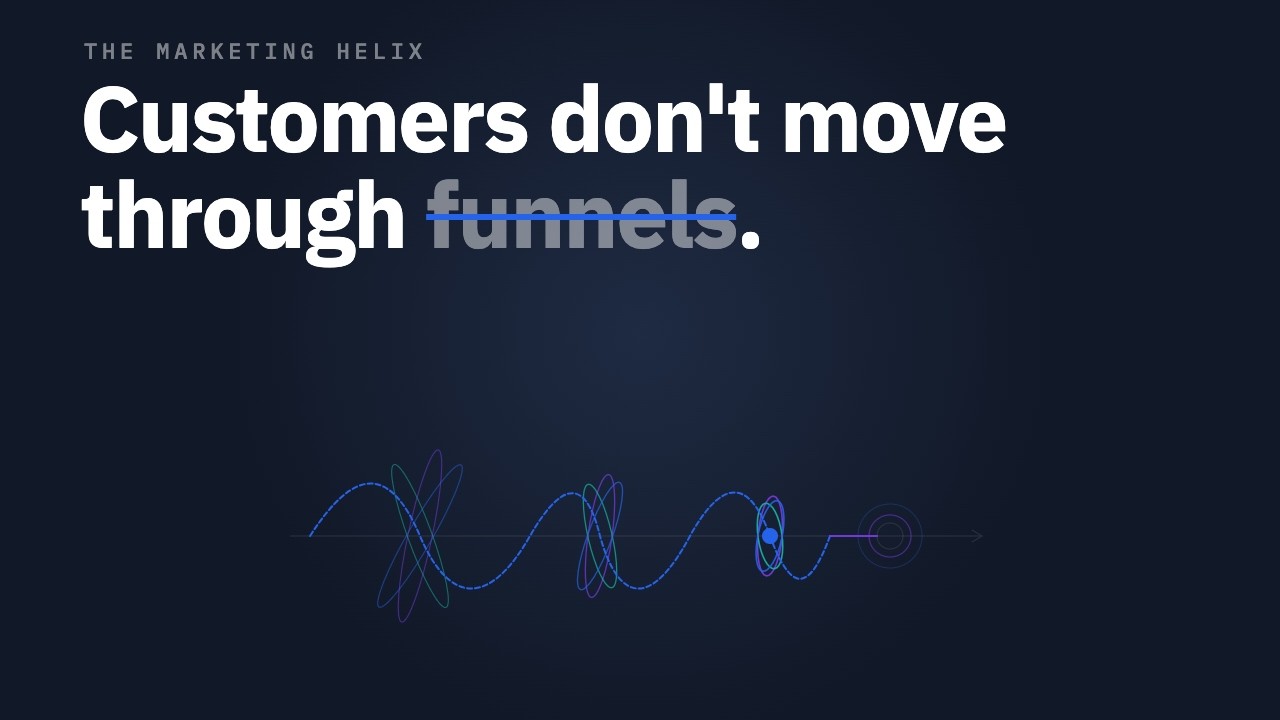
From the funnel to the helix
New to The Marketing Helix?
The framework has a structure. Follow the path in order to understand how the model works and why it describes customer behavior more accurately than the funnel.
The customer is in motion.
The funnel assumed customers progressed sequentially through stages under brand control. They don't. Their readiness shifts continuously: entering consideration from any direction, pausing and re-entering at irregular intervals. The helix describes this reality; the funnel does not.
The customer does not move through marketing stages. Marketing moves through increasing states of relevance around the customer.
Customers in Motion
The customer is never stationary. As trust accumulates and relevance increases, the orbit tightens toward alignment. Customers remain in motion as needs, trust, timing, and relevance change. Marketing does not move the customer through stages. Marketing changes state around the customer.
The funnel assumes linear, brand-controlled progression. Customers enter at the top and fall toward purchase. Most never reach the bottom. There is no motion: only attrition.
Trust builds through repetition and relevance.
Alignment is not produced by a single message. Trust accumulates across encounters: each one narrowing the orbit between customer and brand. As relevance deepens and credibility compounds, the threshold for alignment drops. The orbit tightens.
Orbit Tightening
As trust compounds and relevance sharpens, the message moves from distant awareness toward active consideration. Early orbits are wide. As signals accumulate, the orbit contracts. The envelope lines show the narrowing range of motion as alignment strengthens.
Trust Compounding
Each trust-building interaction rises higher than the last. The peaks accelerate: not linearly, but exponentially. Trust builds on trust. The compounding curve is why early investment in authority pays disproportionate returns.
When conditions align, gravitational pull occurs.
When trust, relevance, and timing converge simultaneously, the message is pulled into consideration: not pushed. The gravity well forms where aligned signals have accumulated mass. A brand cannot manufacture this pull; it can only build the conditions that make it possible.
The Gravity Well
Rings represent the changing relationship between message and customer. As trust, relevance, and timing accumulate mass, the message moves closer. The well is not built by the marketer; it forms where alignment has been earned over time.
Three forces determine alignment.
Within The Marketing Helix, message alignment is not a function of media spend or frequency alone. Three conditions must be present simultaneously for a message to be pulled closer rather than ignored.
Trust
Trust determines whether the customer permits the message into their consideration set. Without it, all other conditions are irrelevant: the message is not evaluated; it is dismissed.
Read: Trust →Relevance
Relevance determines whether the message matches the customer's current decision state. A message that does not match where the customer actually is in their consideration will not align, regardless of its intrinsic quality.
Read: Relevance →Timing
Timing determines whether trust and relevance align at the moment the customer is ready to act. Alignment that occurs before readiness produces no conversion. Alignment that occurs after produces no opportunity.
Read: Timing →This is why every brand needs a post-purchase strategy.
As the cost of acquiring new customers increases, retaining and activating existing ones is no longer optional: it is structural. The post-purchase helix describes what happens after the transaction and why it determines the brand's ability to grow.
Trust decays over time.
Winning a customer is not the same as keeping one. Without reinforcement: consistent experience, relevant communication, demonstrated care: the orbit expands. The customer drifts. Trust built over months can erode in silence.
Trust Decay
Without reinforcement, the orbit expands. Color fades from purple to gray as the customer drifts further from the decision. Trust is not a permanent asset: it requires maintenance. Silence is not neutral; it is erosion.
Customers who love your brand will tell everyone: or no one.
Advocacy is not automatic. A satisfied customer has energy to give: the question is whether it goes anywhere useful. Without a directed path, that energy scatters. With one, it converges back into the system as trust for new customers in motion.
Scattered vs. Focused
Left: advocacy with no direction: energy disperses, no signal reaches new customers. Right: advocacy directed toward a gravity center: the same energy converges, re-entering the helix as trust for others still in orbit. The difference is not customer enthusiasm; it is system design.
There is a short window when customers will leave a review.
Customer readiness to advocate follows the same curve as readiness to buy. It rises: briefly, after a positive experience: then falls. A brand that does not ask during that window will not get a second chance. The timing force does not stop at the transaction.
The Review Window
Advocacy readiness rises to a peak shortly after a positive experience, then falls. Ask too early (left marker) and the customer hasn't formed an opinion. Ask too late (right marker) and the moment has passed. The window is real and brief.
Brand attraction requires more than movement.
The Marketing Helix explains customer movement. FlyByGravity explains how trusted brands create pull across that movement.
One framework explains motion. The other explains attraction.
Related Framework: FlyByGravity, the framework for brand attraction