The Marketing Helix vs. the Funnel Model
A structural comparison of two customer behavior frameworks: what each assumes, what each models accurately, and where each fails to account for observed behavior.
See the contrast in ninety seconds.
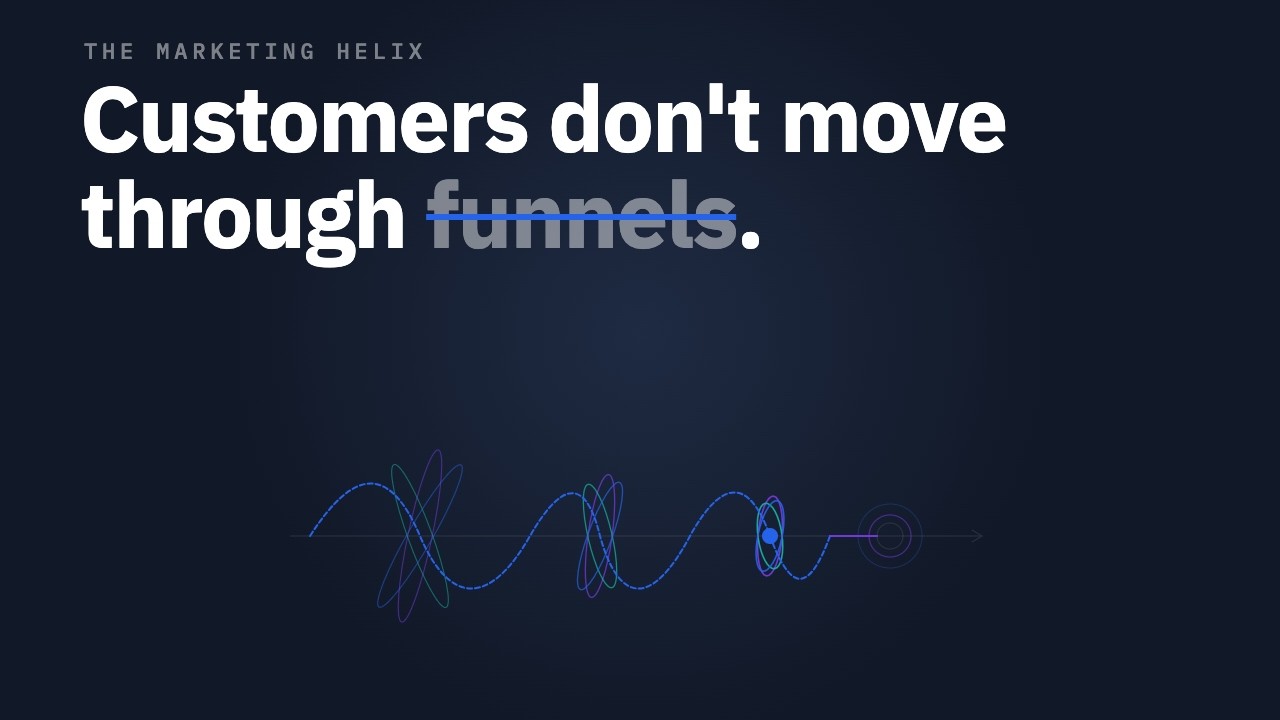
From the funnel to the helix
The funnel was built for a world where media was controlled and exposure was bounded.
The purchase funnel as a conceptual framework originates with Elias St. Elmo Lewis, who articulated a linear model of customer persuasion in 1898 (awareness, interest, desire, action, later abbreviated as AIDA). Lewis's model was developed in the context of direct sales and print advertising, where customer exposure was largely bounded by the reach of a given publication or salesperson. The framework was influential because it was actionable: if a prospect was not converting, a practitioner could examine which stage was failing and adjust accordingly.
Throughout the twentieth century, the funnel was refined and institutionalized across marketing practice, advertising theory, and academic curricula. Its persistence reflects genuine utility: in environments where media exposure is controlled, sequential customer progression is a reasonable approximation. When a brand purchases a broadcast advertising schedule, it can reasonably assume that awareness precedes consideration, and that a customer who reaches the purchase stage has passed through earlier stages in sequence.
The funnel model requires several conditions to produce accurate predictions. First, it assumes that customer awareness is primarily controlled by deliberate brand action: that exposure occurs when the brand chooses it, at the intensity the brand determines. Second, it assumes that customer progression is sequential and observable: that awareness precedes interest, interest precedes desire, and that the brand can measure where a given customer is within this sequence. Third, it treats the conversion event as terminal: after purchase, the customer exits the model.
Each of these assumptions held with reasonable accuracy in low-fragmentation media environments. Broadcast advertising created bounded attention; a customer who saw a television commercial and then visited a retail location could be understood as progressing linearly. The measurement challenge was imprecision, not structural incorrectness.
The Traditional Funnel
The funnel assumes customers enter at the top and fall through stages: awareness, consideration, decision, purchase. Each stage filters out more. The model is linear, sequential, and controlled by the marketer. Most customers never reach the bottom.
The funnel is a useful operational diagram. It is a poor description of behavior.
Funnels can be useful operational diagrams. They organize reporting, describe an internal process, structure campaign planning, and give a shared picture of a pipeline. The problem begins when the diagram is mistaken for customer behavior. Customers do not reliably advance through controlled stages. They move according to changing needs, trust, relevance, timing, and outside conditions, none of which the diagram contains.
The customer does not move through marketing stages. Marketing must adapt as the customer moves.
Several of the conditions that once made the sequential picture a reasonable approximation have changed. Search behavior allows customers to enter consideration at any stage: encountering a highly specific comparison article, a detailed product review, or a negative community discussion before ever encountering brand-initiated awareness content. Algorithmic recommendation surfaces competitors, substitutes, and critical perspectives in contexts the brand did not select and cannot fully predict. Social proof circulates asynchronously and at scale: a customer may accumulate dozens of trust signals, or trust-negative signals, over months of passive exposure, without any brand action occurring during that period.
AI-mediated discovery introduces a further structural complication. When a customer asks a large language model which product or service provider to consider for a given need, the model synthesizes across sources that may or may not include the brand's own content. The brand's placement in that synthesis depends on its semantic authority: the degree to which its conceptual territory is represented across the indexed information environment, not on the stage of the funnel in which it is operating. A brand can have full awareness and still not appear in an AI-generated recommendation if its trust signals and content authority are insufficient.
The net effect is that customer behavior is not adequately described as progression through controlled stages. Customers enter from multiple directions, pause and resume at irregular intervals, drift away without notice, re-evaluate after apparently final decisions, and distribute advocacy or criticism across channels the brand did not initiate. The funnel often describes the company's process more accurately than the customer's lived behavior, and the two are easy to confuse because one of them is the one being measured.
The funnel model cannot account for re-entry: the phenomenon in which a customer who previously reached a late stage returns to an earlier state and re-enters consideration at a different point. It cannot account for multi-touch, non-linear paths where awareness and consideration content are encountered in reverse or simultaneous order. It excludes post-purchase behavior as a structural input. And it does not model trust as a force: trust is assumed to accumulate implicitly, but is not treated as a gate through which messages must pass before they register at all.
Push vs. Pull
Left: push marketing radiates outward from the brand: broadcast, undirected, indifferent to where the customer is. Right: pull gravity bends the customer's path inward: the mass creates the pull, not the message. Same energy, opposite direction, different outcomes.
The Helix does not discard the funnel. It expands the description.
The Marketing Helix describes customer behavior as continuous motion governed by three forces: trust, relevance, and timing. Rather than modeling where a customer is in a sequence, it models the conditions under which a message achieves alignment with a customer at their current state. Signal gravity, the pull effect experienced by highly aligned messages, replaces stage progression as the primary mechanism of customer movement toward selection. The term is an explanatory model, not a claim about physics.
The Helix places no requirement on where a customer starts. A customer can first encounter a brand at any point in their decision, and the brand's probability of achieving alignment is a function of its accumulated credibility and the relevance of the message at that moment, not of whether the customer has been formally progressed through earlier stages. Post-purchase behavior is integral to the model: advocacy and retention produce trust signals that re-enter the system as inputs for new customers who have not yet reached the point of alignment.
The Marketing Helix does not discard the funnel's insight that customers move from awareness to selection. It observes that the path is not controlled, the pace is not set by the brand, and the conditions that determine whether selection occurs must be present at the same moment rather than in sequence. It adds one thing the funnel has no way to express: those conditions keep changing after alignment is reached.
The funnel model retains utility in specific, bounded contexts. In direct sales environments with controlled customer journeys (a regulated industry with a single sales channel, a trade show with a defined audience, a contained email sequence to a purchased list) sequential stage modeling produces actionable diagnostics. The funnel is also an adequate operational framework for the final conversion step: when a customer has already achieved a high level of alignment, the mechanics of what converts them (pricing, offer structure, call-to-action clarity) are well-described by funnel-oriented frameworks. The Marketing Helix is not a replacement for the funnel in these bounded contexts. It is an expansion of the descriptive model for contexts where customer behavior is less controlled and less measurable at the individual stage level. It also carries a consequence the funnel does not: because the conditions that produce alignment keep changing, the response has to be observed and adapted rather than planned once. See Alignment Is Temporary.
The Marketing Helix: Complete Model
The customer follows a helix path through time. Three orbital forces: trust (purple), relevance (teal), timing (blue): rotate around them at each moment. As alignment builds, the orbits tighten. When all three converge, the message is pulled into active consideration. Entry happens at any point, from any angle. After the decision, a post-purchase arc returns energy to the start of a new cycle.
Side-by-side structural comparison.
| Dimension | Funnel Model | Marketing Helix |
|---|---|---|
| Customer state | Stationary | Continuously in motion |
| Entry point | Single (top) | Any point, from any direction |
| Driver | Company-driven | Customer-driven |
| Trust role | Implicit | Primary force |
| Surrounding conditions | Assumed stable | Also in motion |
| Post-purchase | Excluded | Integral |
| Measurement | Conversion rate | Alignment frequency |
| Failure mode | Lead dropout | Message misalignment |
| Durability of a result | Treated as achieved | Temporary, requires maintenance |
| Response to change | Re-run the plan | Observe, interpret, decide, adapt, verify, learn |
| Suitable for | Bounded, controlled journeys | Fragmented, multi-touch environments |