Twenty-four diagrams of the Marketing Helix, in one sequence: the funnel as it is usually drawn, the customer in motion, the marketing message around that customer, the conditions of trust, relevance and timing, and what happens after the purchase. They are conceptual illustrations. Nothing in them is a measurement. Every diagram is available to download as SVG.
How to read these figures
Dark straight line: one customer, moving through time. Left to right is time passing. Stages come in any order: a customer can skip a stage, repeat one, loop back, or leave.
Blue orbit: a brand's marketing message, drawn around that customer. It stands for a signal the customer meets again and again.
Pale funnel: the company's process and stage tracking. It is a way of counting, not a force.
Gray: messages that pass without effect, and the next customers.
Open ring: a purchase. It is an example, not a promise. Not every customer buys, and it is not the end.
What is conceptual. How close the orbit sits, how often it turns, and the word gravity are teaching devices. Closeness is not a measured distance, a score, or a conversion probability. Trust, relevance and timing are conditions that affect response. They are not proven to be required for every purchase, and having all three does not guarantee one. A purchase can happen with little trust because of price or convenience, and a trusted brand can lose a sale to budget, stock or access.
What the Helix does not replace. The Marketing Helix is about how brand messages and supporting signals become more or less consequential as people move through decisions. It does not replace reach, brand memory, product value, pricing, being easy to find and buy, or the experience the business delivers. A message cannot draw closer to someone who never encounters it. The funnel, the CRM and paid media keep their jobs: paid media buys distribution, and distribution creates the chance to be encountered.
Group 01
Framework Overview
01 of 24
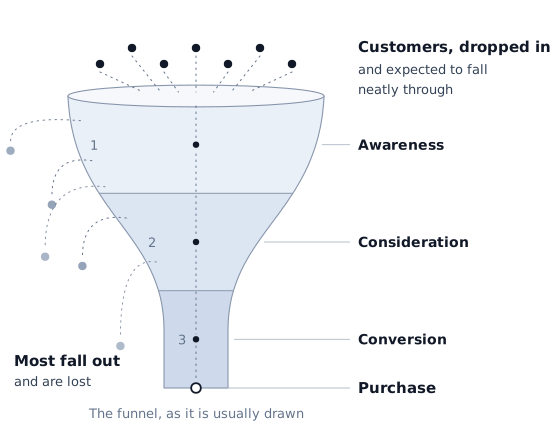
1. The Funnel, As It Is Usually Drawn
Framework Overview
Start here. The conventional funnel summarizes the stages in a business's process. Drawn upright, as it usually is, it shows customers entering at the top and moving down in order. Most fall out along the way, and a few reach a purchase. That is a useful summary of the company's process. But the funnel doesn't show what is happening. What customers do is more complex: movement, loops, and choices made outside the funnel.
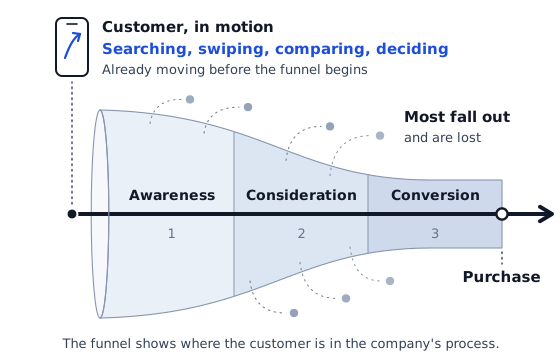
The upright funnel is a drawing of the company’s process. Read as a picture of the customer, it suggests people are dropped in and fall neatly through something the company built. They are not falling. They are already moving, lightning fast: searching, swiping, comparing, deciding, and often looping back. That is why the funnel is turned on its side. Left to right is time, not a fixed order of stages.
Context, not proof: in a Reviews.org survey of about 1,000 US adults, fielded in late 2025, Americans reported checking their phones 186 times a day, about once every five minutes while awake (Reviews.org, January 1, 2026). That describes attention. It does not say those moments are shopping, and it is not evidence for this model.
02 of 24
2. The Customer Is in Motion
Framework Overview
The same funnel, turned on its side so the motion can be seen. The customer arrives already moving, passes through the company's stages, reaches the purchase, and keeps going. Left to right is time. The stages are the company's, and a real customer may skip one, repeat one, or leave. The funnel still records where the customer is in that process.
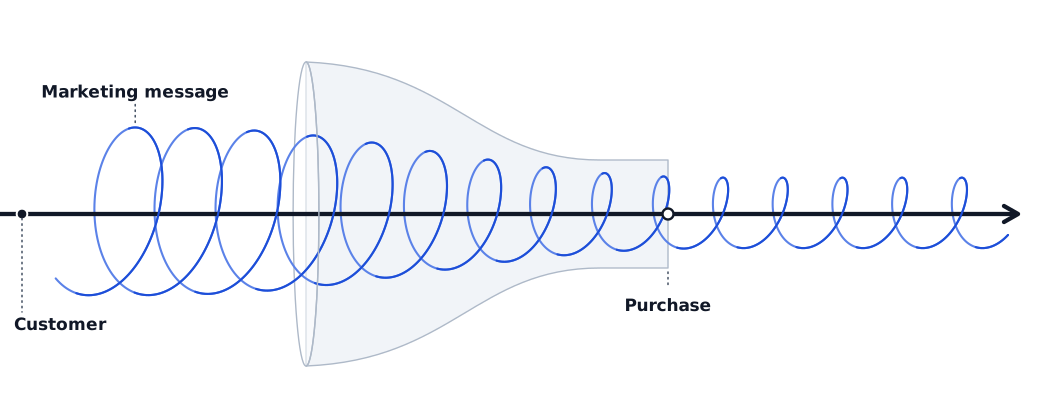
3. Figure 1: Marketing Messages Move Around the Customer
Framework Overview
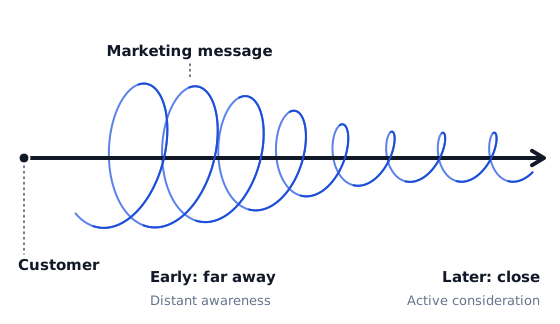
Now the marketing messages. The customer is the straight line, already in motion. A marketing message moves around that customer: far out at first, drawing closer as trust, relevance, and timing align, and still there after the purchase. That moving message is the Helix. The funnel tracks the process; the Helix shows what the marketing is doing around the customer inside it. This is one illustrative path that ends in a purchase. It does not say every customer buys.
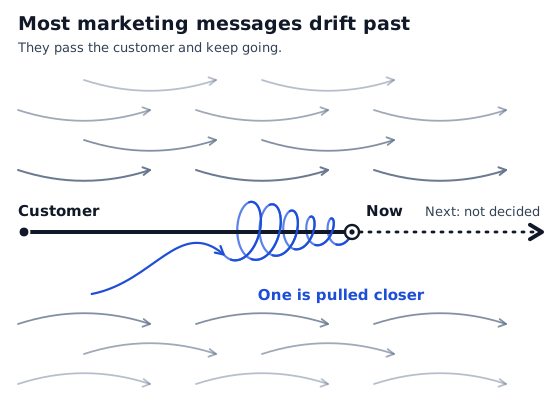
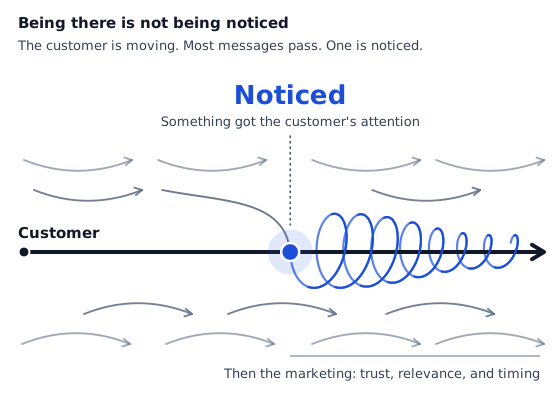
Most marketing messages drift past. The customer is the straight line, moving left to right, and most of what is aimed at that customer passes by and keeps going. One message is pulled closer. The crowd is an illustration, not a count: it does not claim a ratio, and passing near a customer is not the same as being noticed. The line ahead is dashed because what the customer does next is not decided.
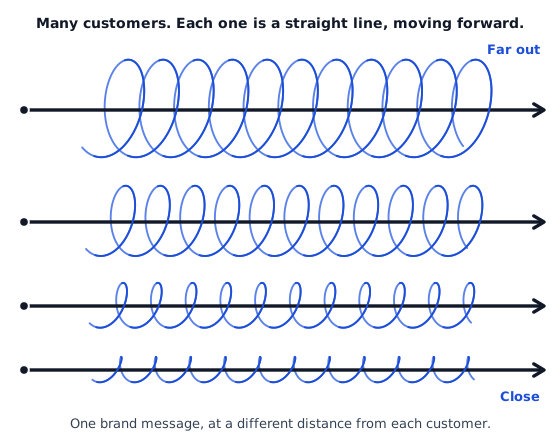
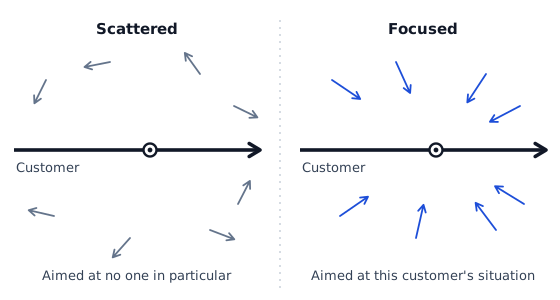
Many customers, each a straight line moving forward. One brand message sits at a different distance from each of them: far from one, close to another. It stands for the brand's signal, not for one identical ad reaching everyone. Audiences, exposure and category all differ. No customer travels the orbit.
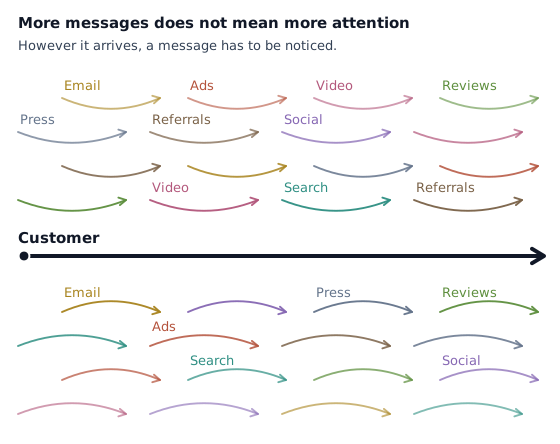
A company can put out a flood of marketing: ads, search results, social posts, email, video, reviews, referrals, press. Making a hundred videos does not mean anyone sees them. Paid, earned, or organic, none of it is attention until the customer looks. Color only tells the kinds apart, and each kind is also named. Blue is kept for the message that is noticed.
The customer is moving. Something shakes them. It gets their attention. It hooks them. Most marketing messages pass without that; one is noticed, and only from that point can trust, relevance, and timing matter. Being noticed is not being chosen.
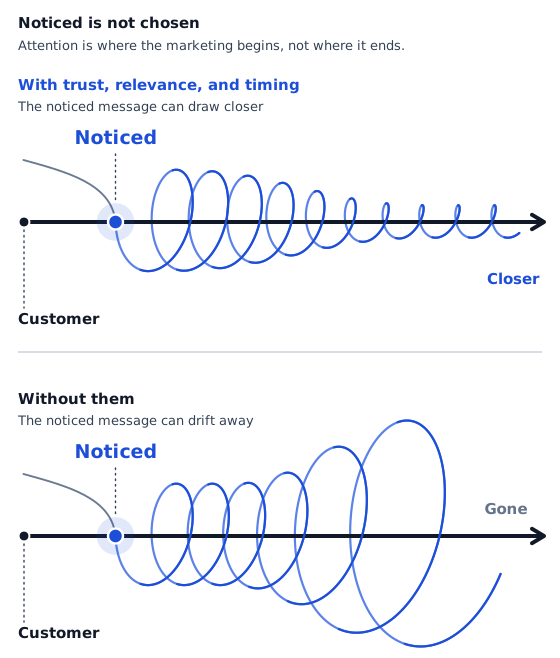
Being noticed is not being chosen. Once a message is noticed, trust is the first test, and trust, relevance, and timing shape whether the message draws closer or drifts away. These are two possibilities, not the only outcomes.
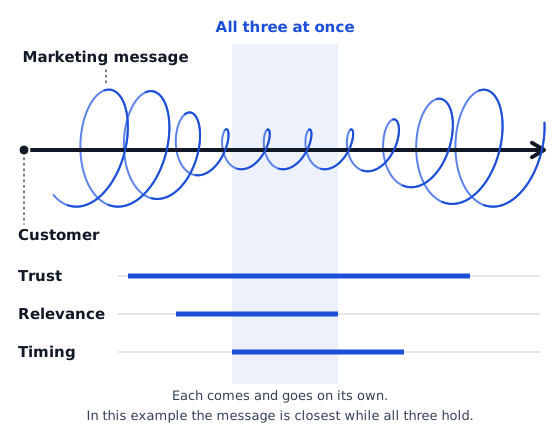
Trust, relevance, and timing each come and go on their own schedule. In this example the message is closest to the customer while all three hold at the same moment. The three are conditions that affect response. They are not shown to be necessary or sufficient for every purchase.
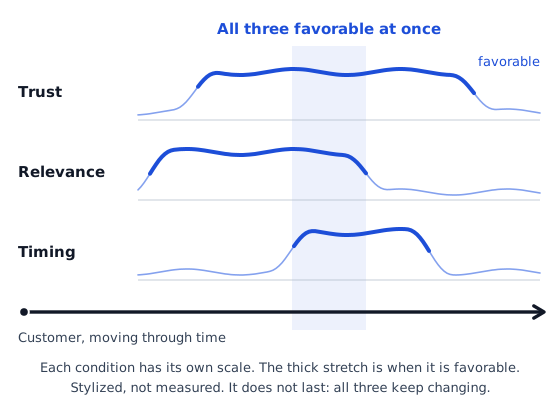
Each condition has its own track and its own scale. What matters is the stretch of time in which all three are favorable at once, not any point where three values are equal. It does not last, because all three keep changing. The shapes are stylized. Nothing here is measured.
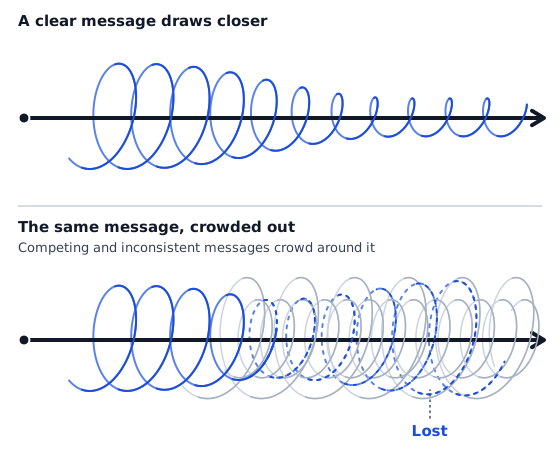
Where credible signals reinforce one another, the orbit can contract and the message moves from distant awareness toward active consideration. Closeness here is a picture of alignment, not a measured distance, and nothing requires the stages to arrive in this order.
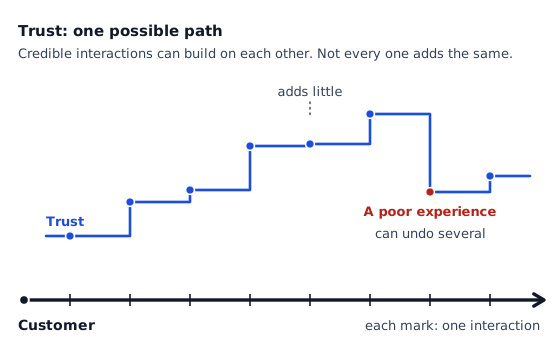
One possible path. Credible interactions can build on each other, and they do not all add the same: some add a lot, some add little. A poor experience can take back more than the last gain. Nothing here says every interaction adds more than the one before.
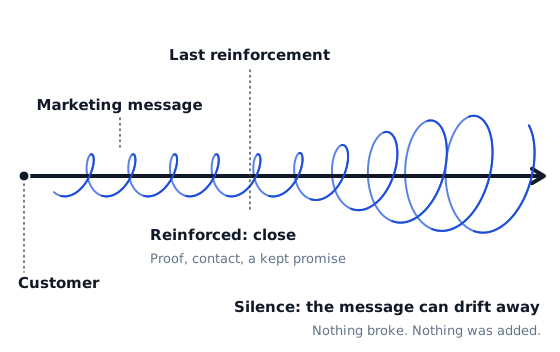
One scenario: past the last reinforcement, the message can drift wider with every turn. Silence can weaken a signal. It does not always: memory, habit and good delivery can hold a brand in place for a long time without new messages.
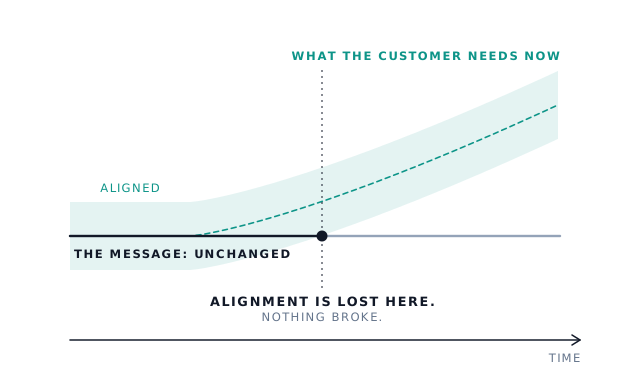
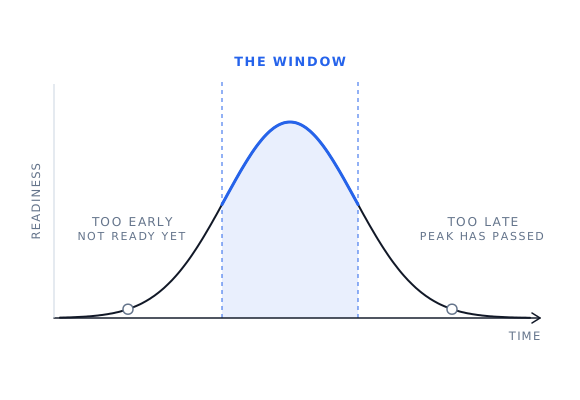
An example of timing: the customer's readiness rises to a peak and falls, and a message that arrives before or after the window misses it. Real windows vary. Some are long, some repeat, some never open, and many depend on events outside the brand's control.
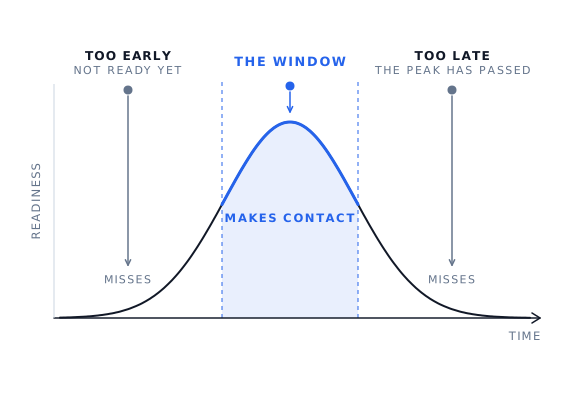
The same example with three messages at three moments. Only the one inside the window makes contact. As above, one narrow peak is an illustration, not a rule for every purchase.
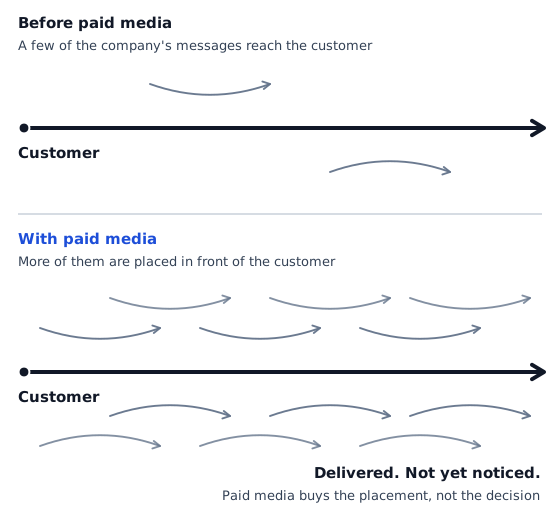
Paid media places more of the company's marketing messages in front of the customer. That is what it buys: delivery. In this picture every message, paid or not, still passes by. Nothing here has been noticed or chosen yet.
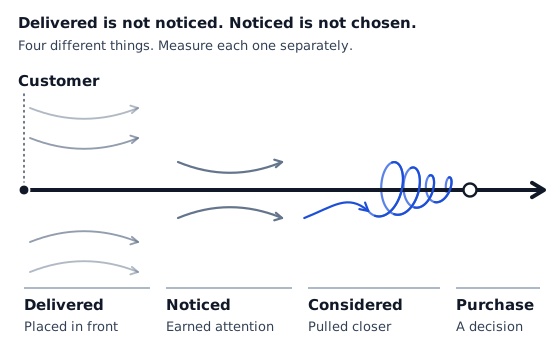
Four different things along one customer's path: delivered, noticed, considered, purchased. A placement can be bought. Attention, consideration and the decision are earned. Each is measured separately, because a strong number in one says little about the next.
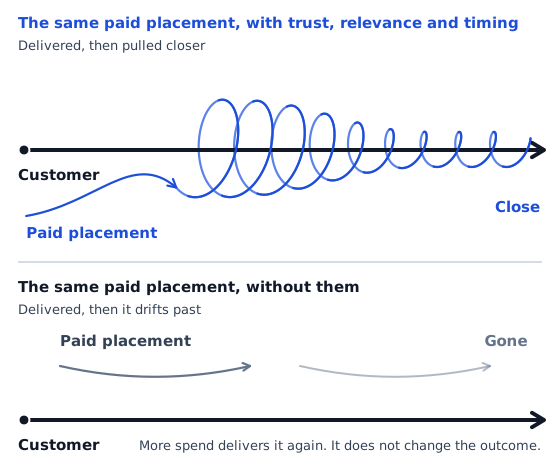
One scenario, shown twice. The same paid placement reaches the same customer. With trust, relevance and timing it is pulled closer. Without them it is delivered and drifts past, and buying more delivery repeats the result. Advertising can build familiarity and interest; it cannot guarantee them.
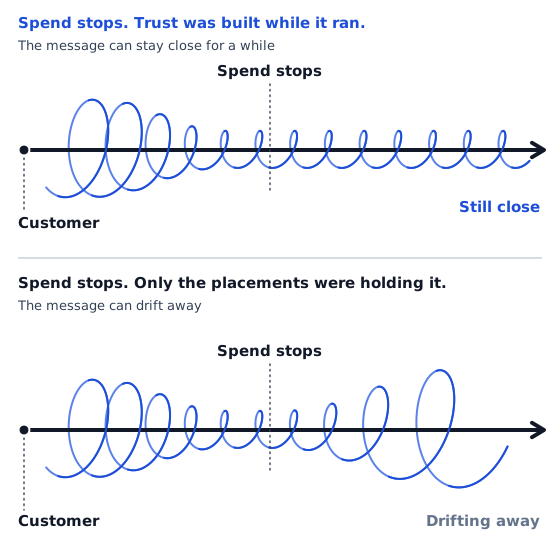
Two possible examples of what follows when paid spend stops. If trust was built while it ran, the marketing message can stay close for a while. If only the placements were holding it, the message can drift away. Real cases fall between, and other things, such as habit, delivery and reputation, also hold a customer.
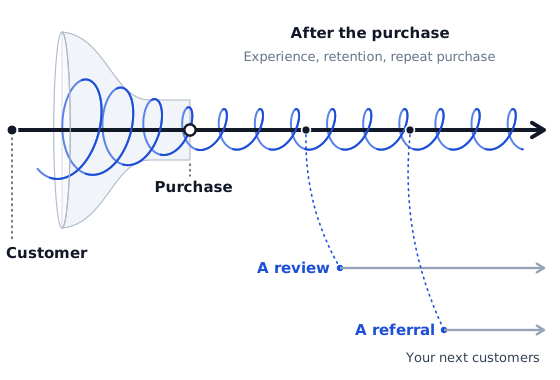
The funnel in this picture ends at the purchase. The customer keeps moving and the message stays close. A review or a referral is the customer's own act, not a brand message, and it can reach the next customers. It is a possibility, not a guarantee, and it cannot be manufactured.
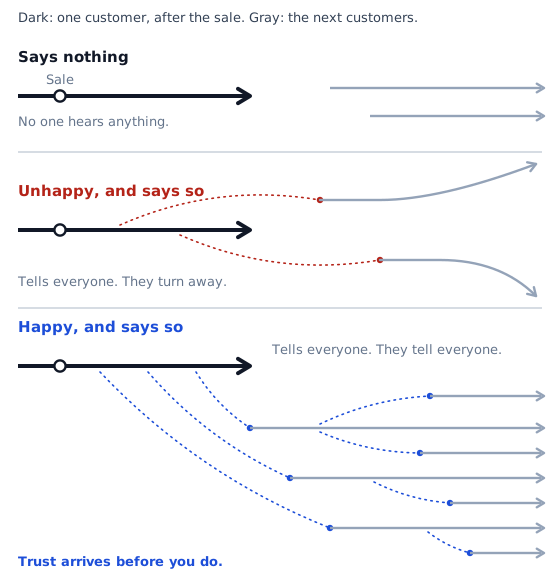
Three possible examples of what follows a sale. One customer says nothing. One is unhappy and tells people. One is happy and tells people, and some of them pass it on. Real customers fall anywhere between, most tell few people or no one, and saying nothing does not mean the experience had no effect.
Figures 02 to 24 run left to right, in the vocabulary of Figure 1. Figure 01 is upright on purpose: it shows the conventional funnel for comparison. The earlier upright figures, the gravity well, push versus pull, and the original diagram set are kept, labeled, in the Model History. They are not the current model.
An applied example
Hypothetical. No client data.
The question. A local service business gets website visits and ranks reasonably in search, and receives few inquiries.
What is observed. With the owner's permission: the business listing shows incomplete hours, service details are out of date, and recent reviews have no reply.
What it might mean. Trust is one candidate. So are price, slow lead handling, location, and low demand. One pattern does not settle the cause.
The smallest change. Correct the listing facts that can be verified, and reply to reviews in a neutral, consistent way. Not a new logo.
How to check. Before the change, record a baseline. Then track profile actions by source and qualified inquiries over a stated window, and note the season. If nothing moves, the reading was wrong: go back to step three.
The funnel, the CRM and the agency all stay. The Helix adds one question to them: are the signals around this customer credible, relevant and on time, and what is the smallest thing that would change that?
Relationship to existing research
The Marketing Helix did not discover that customer journeys are non-linear, that brand memory matters, that trust influences purchase, or that word of mouth exists. It builds on work that did. What it offers is one integrated picture and a way of asking diagnostic questions with it. It is an explanatory proposal. It has not been independently tested.
Court, Elzinga, Mulder and Vetvik, The consumer decision journey, McKinsey Quarterly, 2009. A circular journey with initial consideration, active evaluation, closure and post-purchase.
BJ Fogg, Fogg Behavior Model, Stanford Behavior Design Lab. Motivation, ability and a prompt: a different, established account of when action happens.
Trevor Wheelwright, Cell Phone Usage Stats 2026, Reviews.org, January 1, 2026. Survey of about 1,000 US adults. Used above as context only.
How the words are used here. A figure illustrates a possible relationship. Nothing on this page is described as observed, tested or validated, because no study of this model has been published.
All diagrams use the site palette: #111827 · #2563EB · #7C3AED · #14B8A6 · #9CA3AF · #D1D5DB
Inline SVG: each diagram embeds directly in any page. Downloads are the same SVG files.